ENSO (El Ni?o-Southern Oscillation), the dominant interannual air-sea oscillation, shapes worldwide seasonal weather. Unfortunately, its prediction skill has declined since 2000, especially for weak neutral events like the 2024 case. Most climate models overestimated the intensity of cold ENSO conditions that year, sparking a critical forecasting conundrum. Early spring ocean subsurface cooling initially favored La Nina, yet the event stalled and stayed neutral, confusing most multi-model ensembles.
Addressing this bias, Prof. Fei Zheng’s research team from Institute of Atmospheric Physics, Chinese Academy of Sciences, China, carried out a new study revealing that off-equatorial Pacific warming acts as the core factor halting La Ni?a development, delivering key insights to mitigate systematic forecast biases. These results were recently published in Atmospheric and Oceanic Science Letters.
The team used the ENSO Ensemble Prediction System and pattern clustering to split 100 March 2024 forecast members into best and worst performers for comparison. The analysis found clear air-sea decoupling from May to July. Off-equatorial warm sea surface temperature anomalies in the northeastern and southeastern Pacific induced equatorial westerly wind anomalies via wind-evaporation-SST feedback. These westerlies blocked cold ocean signals from spreading eastward and broke the Bjerknes feedback, arresting La Ni?a at an early stage.
Poor-performing simulations failed to capture subtropical warming, generating fake strong cooling and overestimating La Ni?a intensity. Extra tests with GloSea6 and grouped ensemble samples further verified this conclusion.
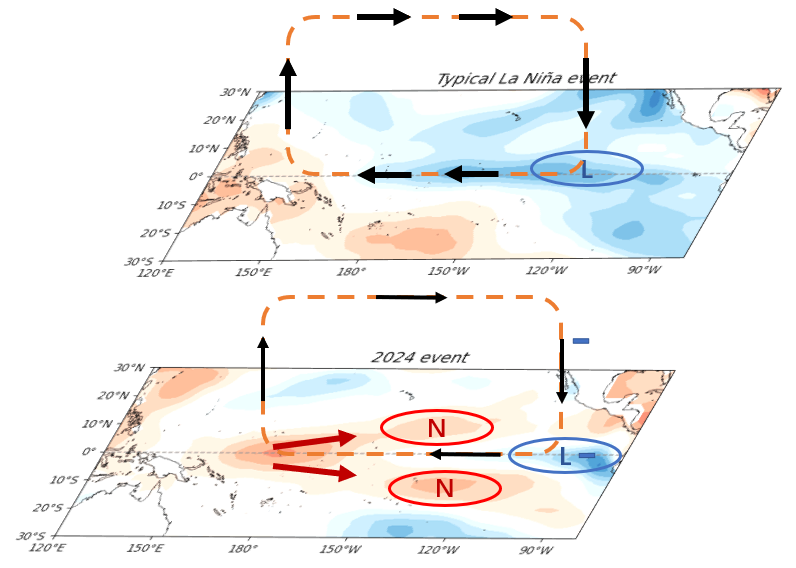
Upper panel illustrates Bjerknes feedback sustains La Ni?a; lower panel shows Off-equatorial warm pools generate westerly anomalies, suppressing La Ni?a in 2024. Credit by Jiayi Shen.
“Subtropical Pacific signals are decisive for ENSO phase shifts, yet most models poorly represent them,” said Dr. Jia-Yi Shen. The team will refine ensemble forecasting frameworks to fully integrate off-equatorial ocean signals, aiming to deliver more reliable seasonal climate predictions for disaster prevention.
Citation:
Jia-Yi Shen, Fei Zheng, Chao-Fan Li, 2026. Key physical processes of the 2024 La Nina suppression from the perspective of air–sea antagonism. Atmospheric and Oceanic Science Letters, 100885, https://doi.org/10.1016/j.aosl.2026.100885.
|







 Editor's choices & News